
There’s a point in a brand’s development where having a logo, some fonts, product photography and a decent-looking bottle isn’t enough.
You’ve got an identity, certainly. But do you have a brand?
That was one of the challenges we faced working with In the Welsh Wind. They already had many of the component parts, but we needed to develop a much richer idea of what the brand meant, who it was for and why somebody should choose these spirits in an increasingly crowded premium market.
That meant looking beyond the bottle.
Premium is something you demonstrate
The spirits market had changed enormously, particularly through the gin boom of the previous decade. Consumers suddenly had an extraordinary amount of choice, with new distilleries, craft producers and premium products competing for attention alongside established global brands.
In the Welsh Wind had bigger ambitions too. The distillery was working towards becoming a true Welsh whisky producer; gin and vodka provided important products while whisky matured, but they couldn’t simply feel like something produced to fill the intervening years. They needed credibility and desirability in their own right.
So we started by looking at what people actually seek when they spend more on spirits. Provenance mattered. Quality mattered. Discovery mattered. There was also something more emotional in the behaviour of people who actively seek out a bottle they haven’t tried before; they’re often telling themselves, and occasionally everybody else around the table, something about their own taste.
Writing ‘premium Welsh spirits’ underneath the logo wasn’t going to achieve much of that.
We needed to demonstrate it.

For those who know what to look for
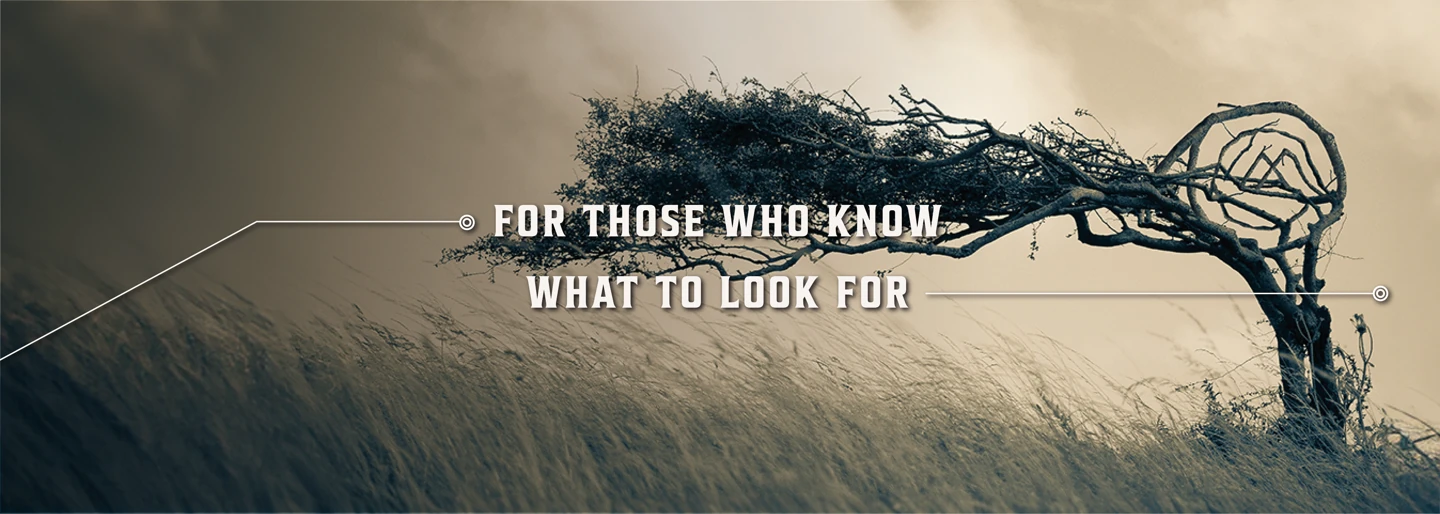
One of the ideas that emerged was ‘For those who know what to look for’.
The line worked because it operated on two levels. Literally, there was something to discover; we took the In the Welsh Wind mark and embedded it into the Welsh landscape, appearing in trees and heather, formed in fields, hidden in clouds and emerging through the movement of the sea.
But it also said something about the person looking.
If you noticed it, perhaps you were someone who did know what to look for. Someone interested in provenance, craft and things that aren't necessarily sitting under a giant flashing sign saying ‘BUY THIS ONE’. There’s a little bit of flattery in that, of course, but premium brands have always understood that what we choose says something about how we see ourselves.
The resulting campaign positioned In the Welsh Wind as something to be discovered.
Importantly, none of the imagery was AI-generated. The work was handcrafted in Photoshop, manipulating the brand mark into the landscapes and combining it with photography, much of which was our own. That distinction feels increasingly relevant now, but at the time it was simply how we made the idea work properly; the craft was part of creating something distinctive rather than finding a shortcut to producing more content.

Making the brand part of the landscape
The Welsh connection could easily have become a cliché.
Put a dragon somewhere. Talk about mountains. Perhaps add a bit of slate and a Welsh flag and congratulate ourselves on a job well done.
We wanted something more intrinsic.
The name itself gave us the opportunity. In the Welsh Wind already sounded elemental; it suggested weather, movement, landscape and place. Rather than putting the identity on top of Wales, we could make it feel as though it had emerged from it.
So the campaign developed a language around wandering misty mountains, crooked paths, rolling hills, coastal dreams and the spirit of the land. The logo wasn't simply stamped onto those images; it lived within them.
That created provenance without having to continually announce ‘we're Welsh’.
The provenance wasn't a marketing invention. In July 2023, Single Malt Welsh Whisky gained protection under the UK Geographical Indication scheme, with In the Welsh Wind among the distilleries behind the application. The protection covers whisky produced, matured and bottled in Wales; a formal recognition of the connection between the spirit and the place.
It also created a much bigger visual and verbal world for the brand to inhabit.

A brand needs to give you something to talk about
That mattered commercially because In the Welsh Wind wasn't working with the media budgets available to the multinational spirits businesses.
There wasn't endless money for television, outdoor, radio and huge experiential campaigns. Digital, social media, the website, bars, restaurants, wholesale relationships and the work of the distillery team all had to work considerably harder.
That's where a properly developed brand becomes useful.
Without a wider idea, spirits marketing can quickly become repetitive: bottle, glass, cocktail, bottle, award, Christmas bottle, glass again.
There are only so many photographs of a bottle next to a tumbler that the world really needs.
Creating a brand world gave In the Welsh Wind more to communicate. Landscape, discovery, provenance, ingredients, craft and the character of Wales could all become part of the story without every piece of content needing to make exactly the same point.
The creative idea wasn't just an advert. It was a platform.

From provenance to belonging
But provenance was only the first part of the strategy.
Once we'd established who In the Welsh Wind was, we could start thinking about where the brand belonged in people's lives.
That took us beyond the obvious assumption that a Welsh spirits brand should simply market itself to Welsh consumers. Wales has a much wider constituency than the people who live there; there are people who return constantly because they have family connections, second homes, caravans, motorhomes, boats, favourite beaches, mountains they walk every year or simply an emotional attachment to the place.
The Welsh word hiraeth became interesting in our thinking: that sense of longing, belonging and connection to home and place.
From there, the audience began to expand naturally along the routes people use to get into Wales. Cheshire, the Midlands, the M4, M5 and M6 corridors, the South West and towards London all contained potential consumers with an existing relationship with the country.
And their relationship with spirits wasn't necessarily about drinking for the sake of drinking. A good bottle was part of leisure, conversation and occasion; evenings with friends, weekends away, dinner, a fire on the beach or a drink after a day outdoors.
That's a very different starting point for marketing than ‘people who buy gin’.

The logo is only the beginning
This is why I sometimes struggle with the way we use the word ‘branding’.
A logo matters. Packaging matters. Typography, colour and photography matter enormously. But they're tools for expressing the brand, not the entirety of it.
The interesting work comes when you connect what the business genuinely is with what the right customer is looking for; then you create enough meaning around that connection for people to recognise themselves within it.
For In the Welsh Wind, the Welsh landscape wasn't simply a backdrop. It became provenance, personality and ultimately part of the product experience.
And ‘For those who know what to look for’ wasn't simply a campaign line.
It was an invitation to the right kind of person to look a little closer.
Because premium branding isn't really about repeatedly telling people you're premium.
It's about giving them enough signals to work it out for themselves.


